
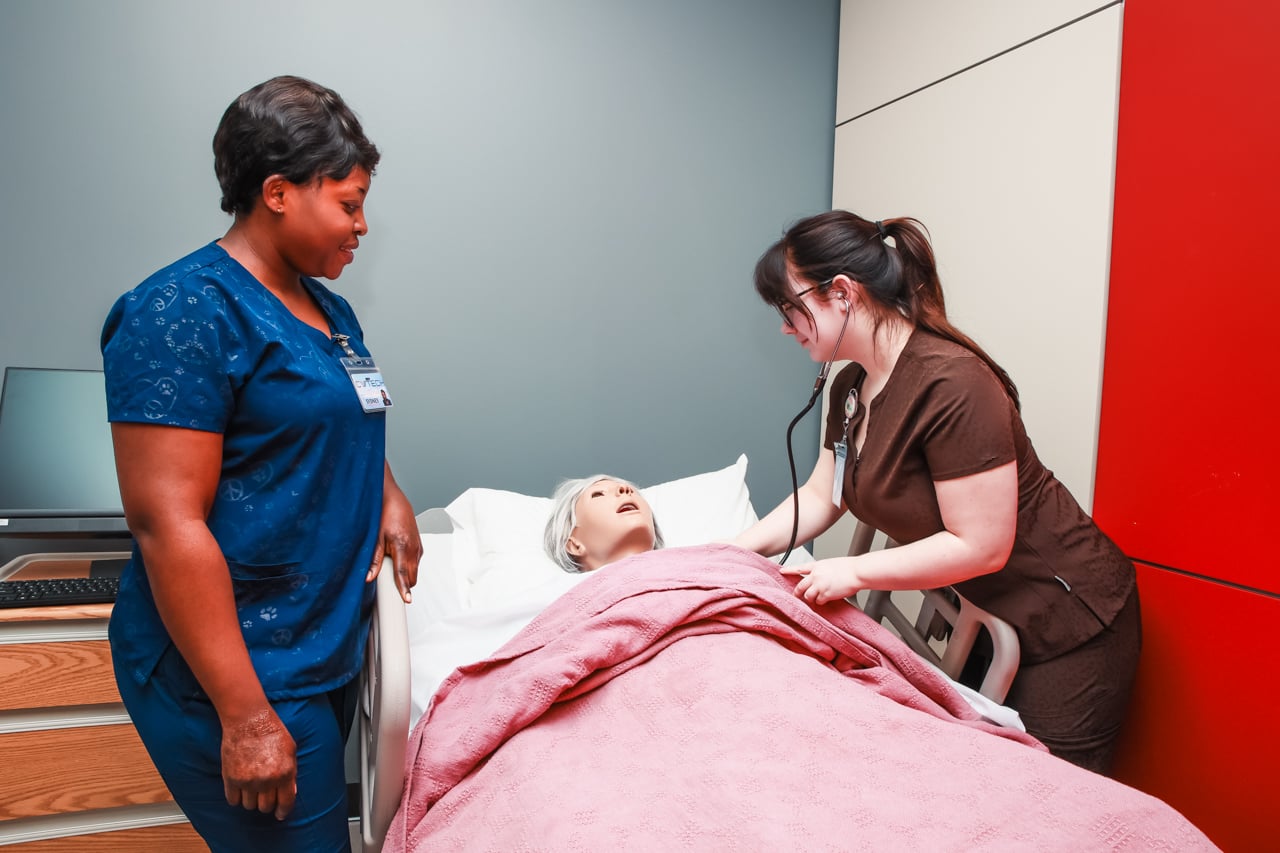
“Susie” breathes, talks, coughs and even moans. She produces realistic lung and heart sounds and responds to treatment like a human patient. She’s not real, but for students learning patient care, she’s close enough to make a difference.
The lifelike mannequin is one of two new additions to the Practical Nursing lab at Canadian Valley Technology Center’s Cowan Campus. The other is a pediatric “patient” named “Joey.” Together, they are transforming how future nurses learn, said Pamela Roberts, director of the PN and Surgical Technology programs.
“We can even run a fully simulated code situation without the fear and high stress of coding a real patient,” Roberts said. “Being able to imitate real-life situations in the lab will help our students master assessment skills, sharpen their critical thinking and clinical judgment skills, and practice high stress situations in the safety of our lab.”
Unlike traditional classroom instruction, these simulators immerse students in hands-on scenarios that mirror real clinical environments. Instead of imagining symptoms from a textbook, students must assess, respond and adapt in real time as they would in a hospital setting. The program’s first simulator, “Noelle,” an adult birthing mannequin, was acquired three years ago through an American Rescue Plan Act (ARPA) grant.
“We’ll also be able to debrief the situations to help the students reflect on the scenario and outcomes, which will increase learning,” she said.
That reflection component is key. After each simulation, students review their decisions, discuss outcomes and refine their approach, an evidence-based method proven to strengthen clinical judgment.
The technology also enhances instruction. Nursing education often relies on kinesthetic learning, where students grasp concepts best by doing rather than observing. These simulators allow instructors to replicate bedside conditions, giving students repeated exposure to critical scenarios before they ever treat a live patient.
During a recent pediatric simulation, “Joey” presented with an asthma exacerbation. A student quickly identified wheezing and stridor, recognized a drop in oxygen saturation and administered the appropriate simulated medications to stabilize the patient.
It’s a controlled environment, but the stakes feel real. And that’s the point.
By blending advanced simulation with guided instruction, CV Tech is preparing students to step into clinical settings with confidence, competence and experience already in hand.
